On this page you will find artwork I have commissioned from some of my favourite artists, so I could use their fabulous work to enhance my teaching sessions!
I subscribe to the “Stained Glass Window Theory” when teaching. What does that mean? Well, imagine you’re in a medieval church, you’re bored and the sermon isn’t helping. Your gaze drifts from the speaker to the the stained glass windows, the very stained glass windows which depict the characters and values which the church was hoping you’d learn!
Reading texts is not everyone’s most preferred or practical method of learning. Having artwork to both supplement and enhance the texts we study is an incredible pedagogic gift. If I’m exceptionally lucky, getting to experience artistic adaptations of what we’re studying will encourage a learner to feel validated and encouraged to process or celebrate their learning through an artistic medium as well! In a multi-week course, I’ll conclude with a Sugya Show-and-Tell, where everyone is invited to share poetry, painting, puppetry, pastries – whatever our learning inspires them to create 🎨
Artwork inspired by stories and figures in Talmud is exceptionally rare, and I’ve spent many hours scouring the internet for it! My hope is that anyone who has been in my shoes finds there way here and can share the fabulous contributions made for me and my learners by the artists below. If you’re a Talmud artist, please please please tell me so I can spread the word about your work as well!
“The Two Miriams and the Angel of Death” by Willy Mendes

This black pen/marker line illustration depicts a legend found on Chagigah 4b-5a. The story explains that our Angel of Death (here depicted as a menacing, long fingered femme rising up from the background), is fallible, in that it can mix up the soon-to-be-deceased when they have the same name. In this case, we have two Miriams whose profession is M’gadla. From the root גדל, for one, this is a profession of raising/braiding hair, while for the other it is a profession or raising/teaching children! Both are show in the midst of their work. This was made for a session called “Women in Talmud – Who Would You Be in the Third Century?” because I loved the quick insight into these important roles for women and their dramatic encounter with the supernatural.
Barbara “Willy” Mendes is an icon of the 1970’s underground comics scene and a fabulous muralist. See more on her website!
“Marta, the Richest Woman in Jerusalem” by Barbara “Willy” Mendes
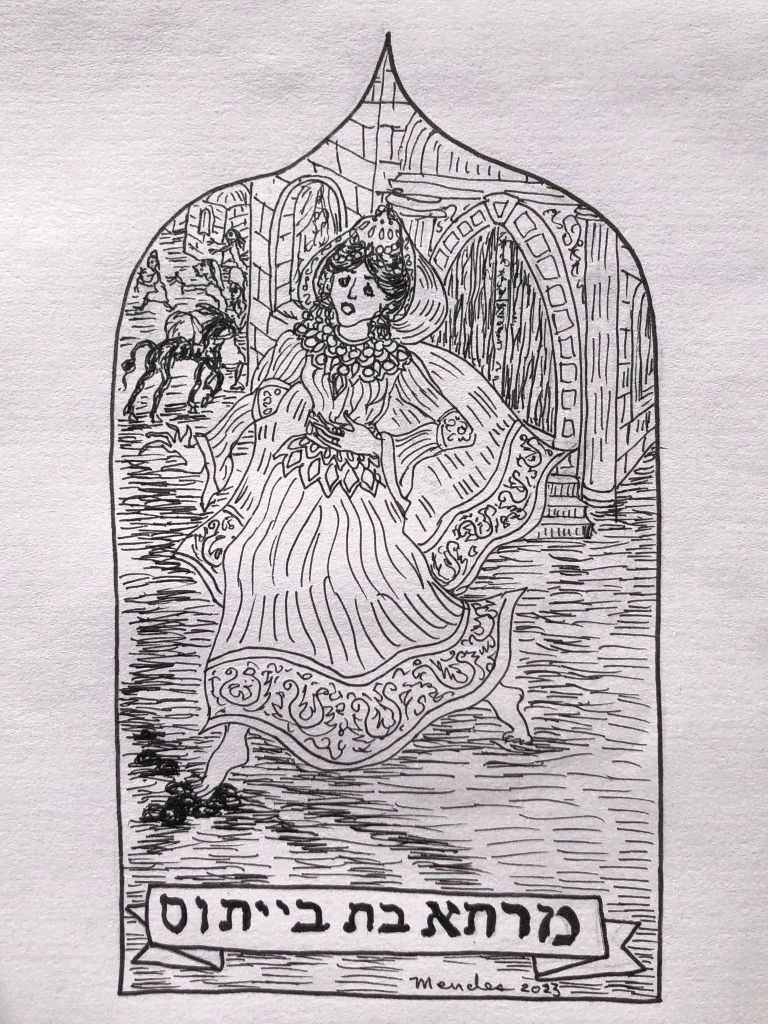
This black pen/marker line illustration depicts a legend found on Gittin 56a. Marta bat Boethus was the Richest Woman in Jerusalem when it sieged by the Romans (leading to the destruction of the 2nd Temple in 70 CE). The story is somewhat of a farce, where she sends a servent out to look for the best flour, but he comes back saying they only have the second-best flour left. She sends him out for it, but by the time he gets there, only the third-best flour is left! This continues until she decides to take matters into her own hands, goes out without shoes on, steps in shit and dies. She is depicted here in a lovely dress in the moment of stepping.
Barbara “Willy” Mendes is an icon of the 1970’s underground comics scene and a fabulous muralist. See more on her website!
“Agrat bat Makhlat” by Yotzeret Sheydim

This is an acid etching on copper 1’x1′ in size. The Demon Queen Agrat bat Maḥlat (“Scraping, Daughter of Sickness” in my translation) has her biggest moment in Talmud on Pesachim 112b, where the sages warn people not to go out alone on Tuesday night or Shabbat nights, for that is when Agrat and her 180,000 angels of twisting ruin (malachai chavalah) are out and about. This warning is etching in the Hebrew at the bottom, while Agrat’s name is in the top right, and the angels are peppered throughout.
This work has an accompanying noise music composition, recorded by moving a contact microphone across the scratches while speaking the text into the metal. True demon music.
Yotzeret Sheydim (“Creatrix of Demons”) is a noise musician and jeweler. The noise piece “Agrat” may be found on her Bandcamp.
“Eulogy of the Women of Shechantzib” by Ren Finkel
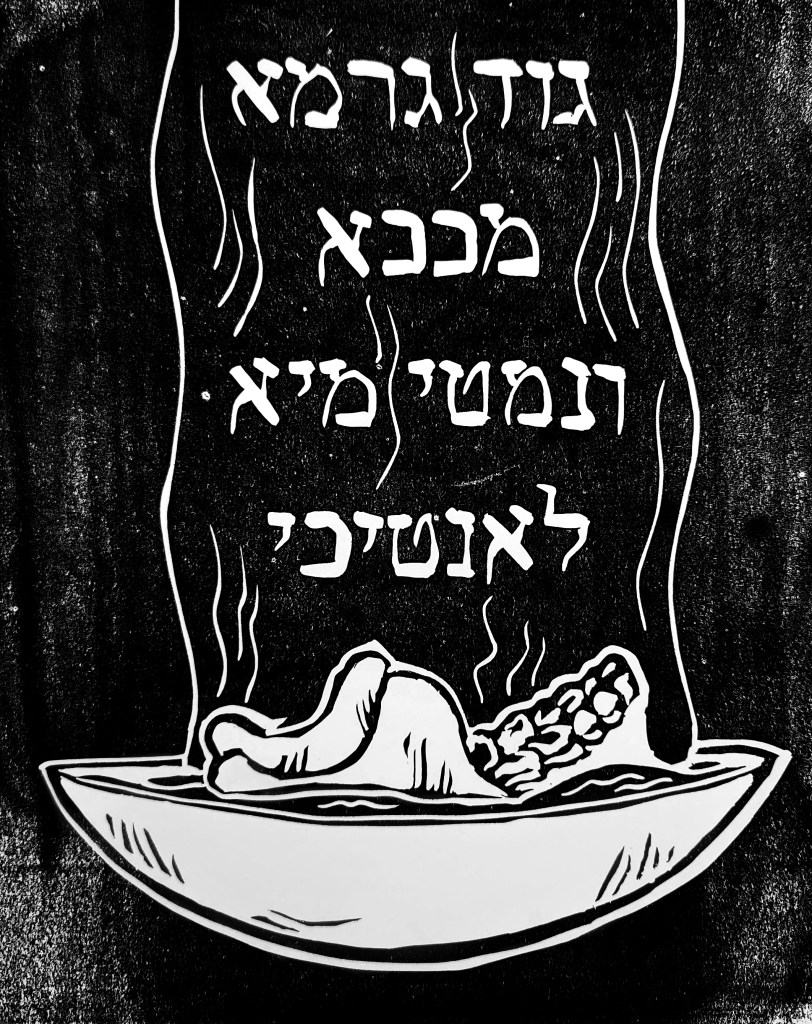
Black and white linocut print based on Moed Katan 28b. This daf describes the role of professional mourning women, wailers and clappers and eulogists. The Gemara recounts specific sayings of the women in the town of Shekhantziv. They are exceptionally cryptic and an exciting challenge to translate! This piece contains the text:
אמר רבא, נשי דשכנציב אמרן: ״גוד גרמא מככא ונמטי מיא לאנטיכי״
This design follows the translation of Rabbi Adin Steisaltz z”l found on Sefaria: “The bone has been removed from the jaw and the water returns to the kettle.” But you could also translate it as:
“The pitcher has strayed away from the tent, and we must take water in the bowl” (Sekles via Rev. H. Gersoni)
“Cut the tooth from the bone, and let the water run into the bowl.” (Sekles)
“Take the bone (pin) out of the jaw (the base in which the vessel is suspended) and let water be put into the antichi (a receptacle for vessels, a stand for hanging in kettles, tripods) i.e. body and soul are now separated, the latter being the vessel going back to the (divine) spring.” (Jastrow)
“She is bringing a leather wine bag from the cup, and we will bring water for the cauldron.” (Olivia Devorah Tucker)
Message me for a full class on these texts!
Ren Finkel (they/them) a visual artist and Jewish educator working in Philadelphia, PA. Through installation, physical collage, photography, and linocut prints, their work attempts to unite political with personal. Their older work can be found at www.renrathbone.com
“Portrait of Toni Ebel (left, 1881-1961) & Charlotte Charlaque (right, 1892-1963)” by Hani Portner

These two were Jewish trans women and lovers; in their letters they called each other “Geliebte (Beloved).” Separated by the Holocaust, Toni lived the rest of her life in East Germany, continuing the landscape and portrait painting career that had allowed her to transition. Charlotte acted and taught in NYC, known as the “Queen of Brooklyn Heights Promenade. The painting is based on this photograph:
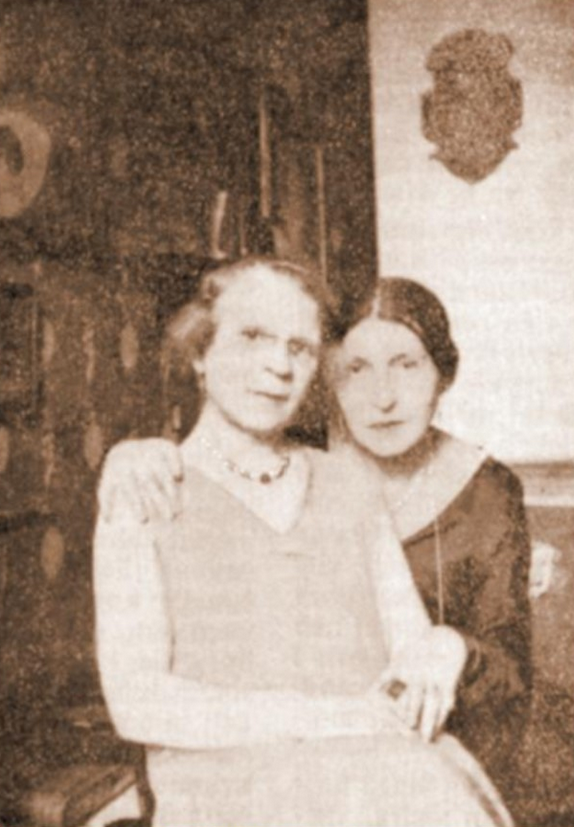
This was commissioned to support a session discussing a rare mention of lesbian relations in Talmud (Shabbat 65a-b), as a way to show that queer Jews have always been around, even when history has minimized their memory.
Hani Portner (they/fae) paints and shares the lives of trans and queer people involved with Magnus Hirschfeld’s Institute @friends_of_dora.
“Wife of Rabbi Chaninah ben Dosa” by Miriam Saperstein

This coloured pencil & marker illustration & the following painting are inspired by Taanit 24b-25a. I consider this narrative the closest that the Talmud comes to passing the Bechdel-Wallace Test – a litmus test for feminism in media which assesses if there are two (preferably named) women, who have a conversation with each other, about something that isn’t a man.
In this story, the nosy neighbour (maybe named Ikku) of Mrs. Chaninah ben Dosa tries to expose the latter’s poverty by bursting in on her when she is making smoke – so that it looks like she can afford to bake bread. A miracle occurs for her and her kneading bowl and oven are overflowing with dough!
About this piece, Miriam says: “I’m taking a class called “How to Braid” with Prof. Aisha Sabatini Sloan where we’ve been thinking about all kinds of braids including challah and braided hair. This piece evokes the braid that happens between the two women and Allison Bechdel’s voice in her comic. There’s also arguably a fourth woman’s voice, as the name for g!d’s voice is “daughter of the voice” or Bat Kol, which is participating in the story. The stories combine, with the parts “behind” the visible parts of the braid representing the hidden motives and emotions not preserved by the text.” (2019)
Miriam Saperstein can be found @bitter_water_babe and their work is linked on their linktree!
“Wife of Rabbi Chaninah ben Dosa” by Icarus Haven
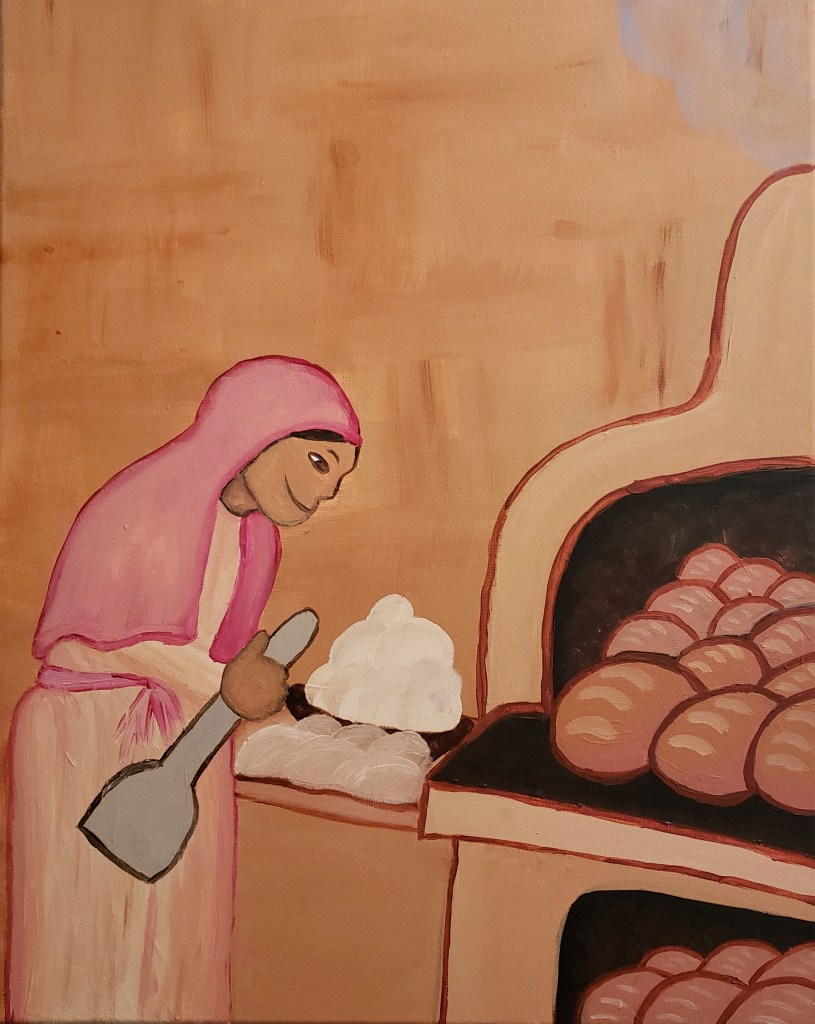
“The style was inspired by Jewish Mosaic art that I came across! I tried to pick colors and attire that Rabbi Hanina Ben Dosa’s wife would have worn but it came out a tad pink!” – Icarus Hunter (2019)
“Demons in the Trees” by June O

This pen sketch was inspired by my Tu BiShevat class “Demons in the Trees,” based on Pesachim 111a-b. It features many elements of the discussion, including: that demons were made at the last sundown before the first Shabbat; dangerous shadows (palm trees, boats, etc); angel illustrations from amulets; rishpe the name of rooftop demons; and the Trees of Life and Knowledge. On the trunk it says “Whatever has many branches, it’s shadow is dangerous.” It has a couple cute mushrooms too!
June O (they/them) is an art therapist in training in Pittsburgh, PA. Follow this art @jun.e.art_ .
“Like Hair from Milk” by June O
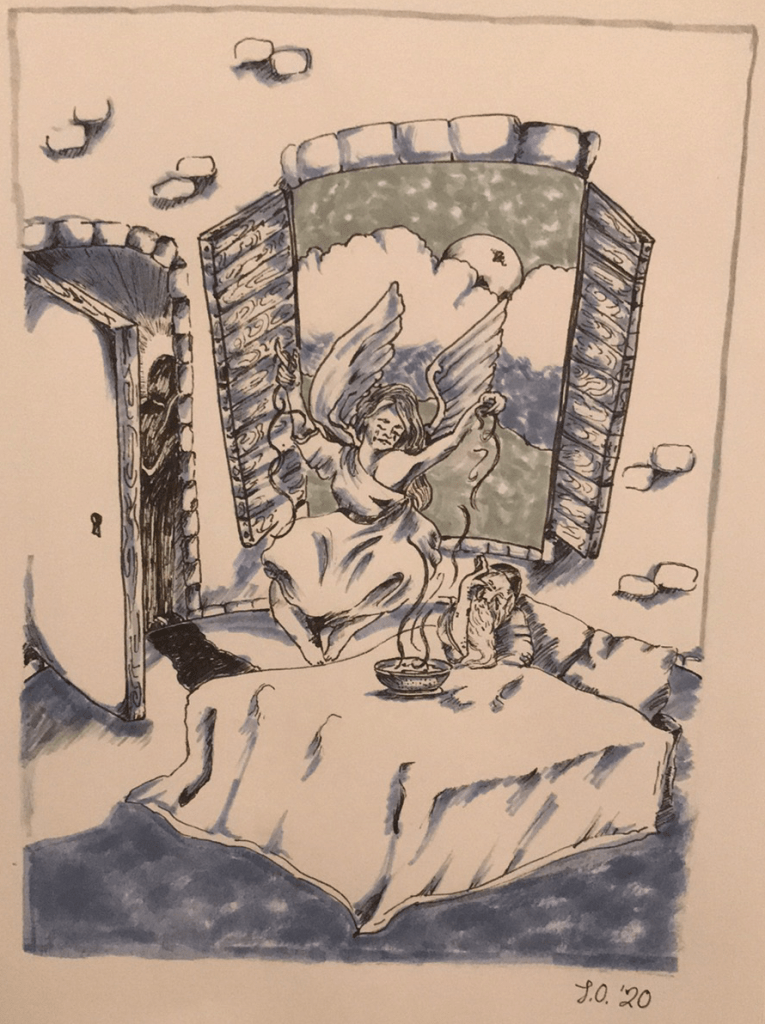
This illustration is based on the legends shared in Moed Katan 28a. The passage (which is found before the mourning women also discussed on this page) tells about the deaths of some sages and their relationships with the Angel of Death. Rava asks Rav Naḥman to visit him after he dies. Rava asks the ghost of his friend “What was dying like?” Rav Naḥman says, “Like pulling hair from milk,” so gentle ad easy, “But I would not do it again, because my fear of death is so great.” Here a long, sharp fingered angel pulls wisps of hair like steam from a bowl on the sage’s bed.
June O (they/them) is an art therapist in training in Pittsburgh, PA. Follow this art @jun.e.art_ .
Check back for future art!
It has been such a privilege to work with these artists ~ remember to support the artists in your life!
 Talmud Magic with Olivia Devorah